
Proactive Dentistry Isn't Doing Less Dentistry
If your practice leans into proactive dentistry, will you end up doing less dentistry? That's usually the first question a practice owner asks. The opposite misreading is just as common: that being proactive means treating problems before they hurt. Neither is quite right. Relieving pain and restoring function is essential care, and it isn't going anywhere. What changes is what happens after the treatment. Once the symptom is gone, many patients don't come back until the next problem, and the months in between go unrecorded. This post covers where reactive and proactive care actually diverge, two myths that keep practices from making the shift, and where a preventive dental practice can realistically start.
What's the difference between reactive and proactive dentistry?
The difference isn't how much you treat. It's where you start. Reactive care responds to symptoms, discomfort, and confirmed problems. It relieves pain and restores function, and it will always be at the core of dentistry. Proactive care adds one more layer: look at the current state, keep a baseline to compare against, explain what a change means, and plan prevention, observation, or treatment as needed, along with when to look again.
| Perspective | Reactive-weighted care | Proactive-weighted care |
|---|---|---|
| Starting point | Symptoms, discomfort, today's problem | Today's problem plus a baseline, any change, and care needs |
| Key question | What needs fixing now? | What do we see, what's changed, and what do we do next? |
| How information is used | Same-day decision and treatment explanation | Same-day decision plus a reference for the next comparison and for ongoing care |
| Patient's role | Comes in to get a problem solved | Understands their condition and takes part in daily care and reassessment |
| How the relationship runs | Organized around treatment events | Education, prevention, needed treatment, and maintenance keep cycling |
This isn't a new kind of dentistry. You already have recall exams, prophies, and perio maintenance. Proactive care runs them more consistently with images and records, so one visit actually connects to the next.
Preventive and proactive aren't quite the same, either. "Brush twice a day and floss" is preventive advice that fits everyone. Proactive care is specific: here's the spot on this patient, here's how we'll manage it, and here's when we'll look again. Physicians check blood pressure at every visit and watch the trend; dentistry can do the same with biofilm, which keeps coming back, by recapturing it the same way and keeping the record.
Two myths about building a preventive dental practice
Myth 1: "Proactive means treating earlier." It doesn't mean moving every patient's treatment forward. For the right patient, choosing education or observation is proactive care too. Red fluorescence on a Qray fluorescence image, for example, doesn't by itself mean treatment is needed. It shows where mature biofilm is sitting, which is a reason to look closer. Whether to manage, watch, or treat is the dentist's call, made together with radiographs and other exams.
Myth 2: "Proactive means doing less dentistry." Necessary treatment stays. What changes is what happens after it. Running needed treatment alongside prevention and maintenance, so that treatment results feed back into care and reassessment, is called Hybrid Care. A proactive practice isn't doing less; it's extending a relationship that used to end when the treatment did.
Dot, line, sphere is a simple way to picture it. A dot is treating a specific tooth or site. A line is the path from exam to diagnosis to treatment. A sphere is the whole patient-centered environment where records, treatment, consultation, daily care, and the next visit connect. It isn't a ranking of practices; it describes how far, in time and into the patient's daily life, the same practice chooses to look.
What does a proactive visit add?
Four actions connect one visit to the next. Before thinking about devices or software, check whether these four already happen in your workflow.
- Observe: make today's condition visible.
- Record: keep a baseline to compare against.
- Compare and explain: put it next to the last record so the patient understands.
- Carry into care: agree on what to do at home and when you'll look again.
On a first visit, today's image is the baseline. If there's a previous record, compare. If not, today becomes the reference. That goes for healthy-looking patients too: a baseline captured while things look good is what lets you show exactly what changed if something starts later, and "no change" is useful information that supports continuing the current plan.
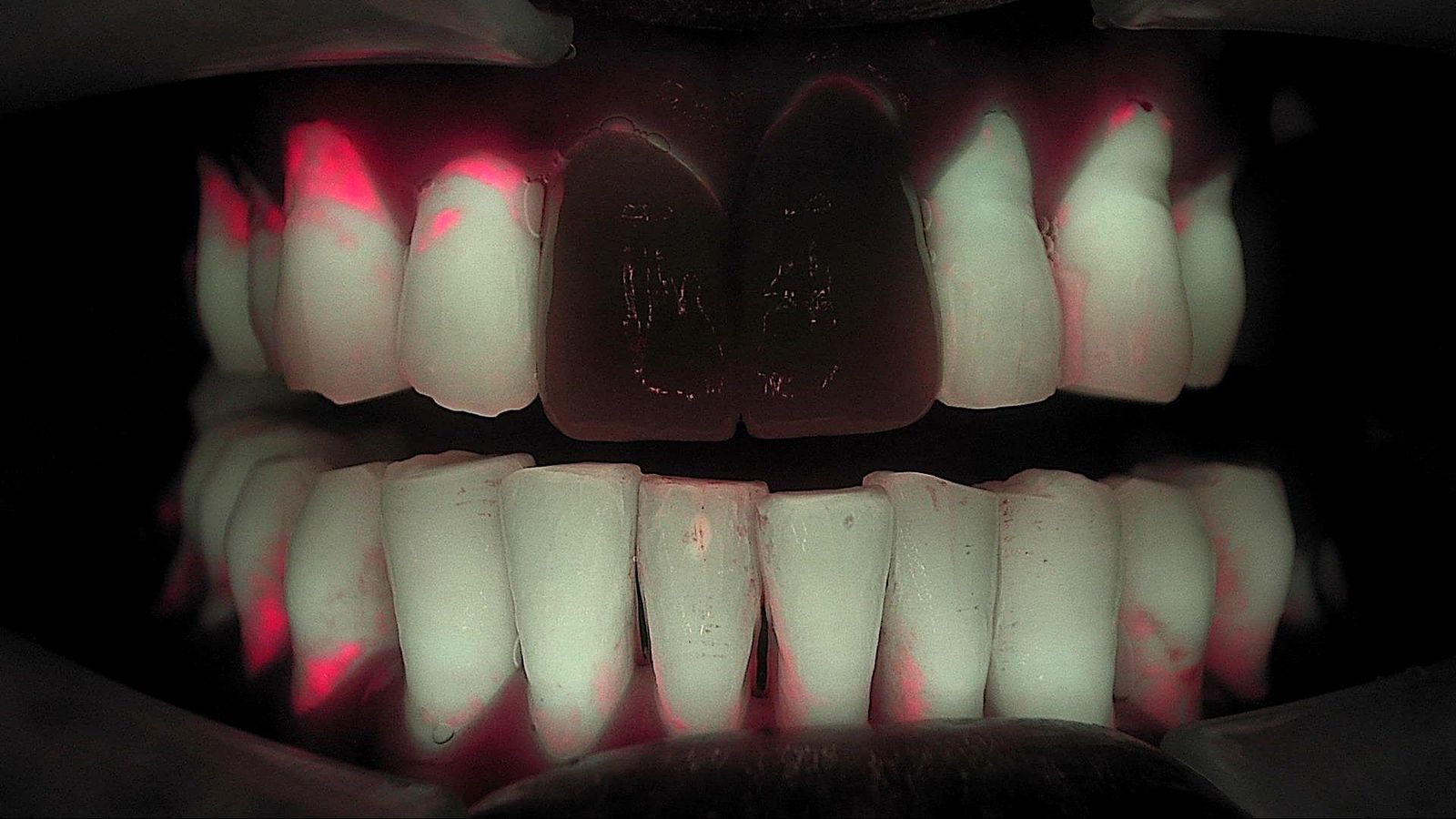
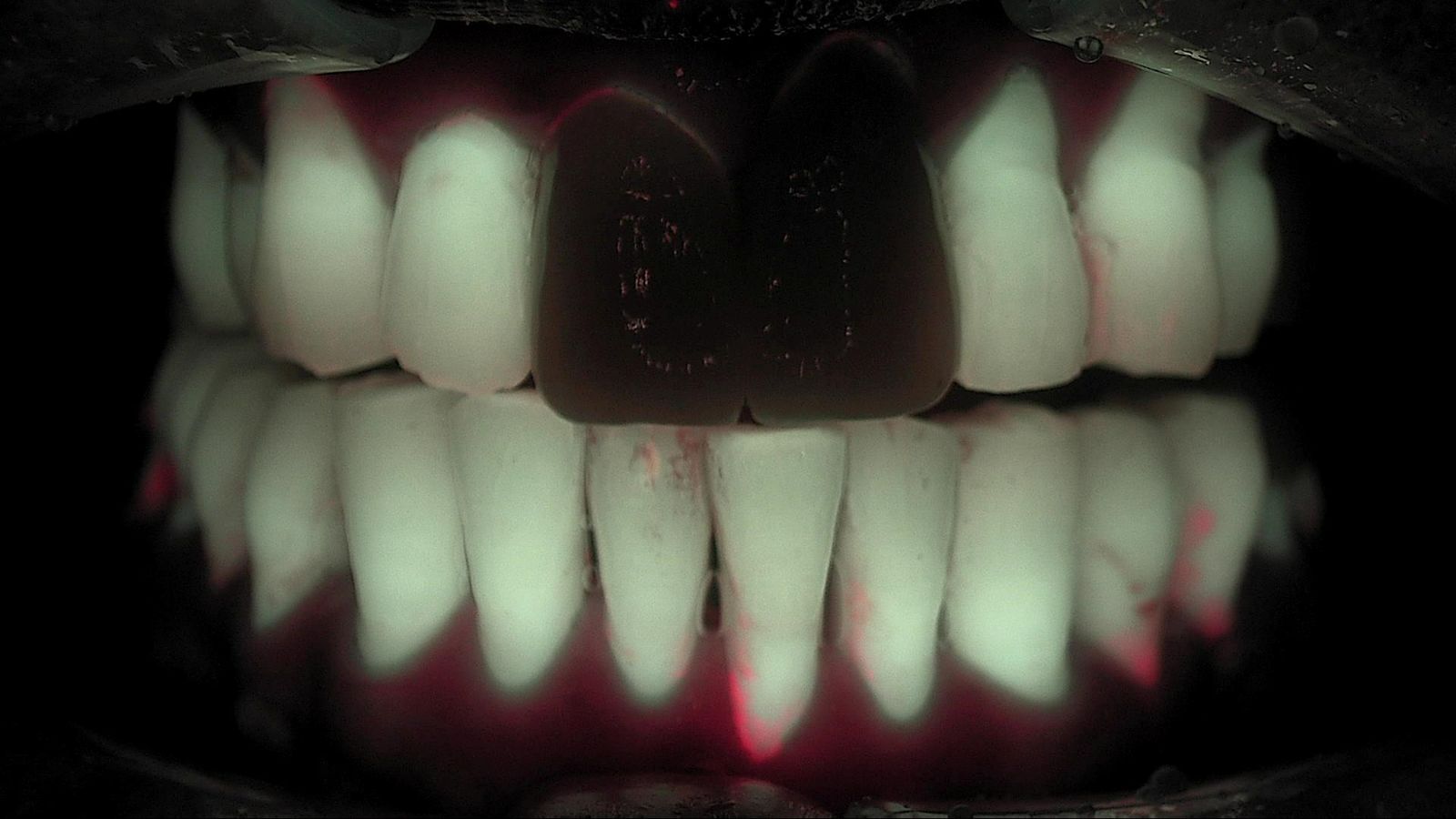
Same patient, ten months apart, both captured before scaling from the same angle. The first image recorded that day's condition and became the baseline for the next visit. In the second, the red along the upper lateral incisor and canine margins looks reduced, while some red remains on the lower arch. The reduced areas are a reason to keep the current plan going; the remaining areas become the next target. The two upper central incisors are restorations, which fluoresce differently from natural teeth, so they look dark in both images. For how to compare images like these, see Intraoral Photo Comparison: Last Visit, Side by Side.
There's evidence that seeing can come before doing. In a randomized study of 100 adolescents aged 14 to 16, the group that checked their own plaque with a QLF-based handheld device during oral health education and plaque-removal training had a plaque index of 0.07 after eight weeks, compared with 0.46 in the group taught the traditional way, along with higher scores for oral health knowledge, attitude, and behavior. These were students in a school setting, not dental patients, so the result doesn't transfer directly. It does support the idea that observation and education are proactive care in their own right.
How do you make recall a reason to come back?
Start with what you call the visit. "See you in six months for your cleaning" sounds like a housekeeping appointment, and "cleaning" doesn't tell the patient much. Try: "Next time, we'll capture this same area from the same angle and see how your gums and implants are doing." Whatever you call the visit, the patient should know what you'll be checking.
Set the next check by what you saw today, not by the calendar. If the comparison shows things are going well, keep the interval. If red areas have increased or there's something new to watch, look again sooner. The dentist sets the interval and the method for each patient and records the reason.
Everyone on the team adds one line to the same image. The conversation doesn't get longer; the patient simply starts to understand before the doctor walks in.
- Hygienist: captures the images, explains what the red means, and starts the record.
- Dentist: reviews the images together with other exams, confirms the findings, and decides between treatment, observation, and education.
- Assistant: pulls up the previous visit's images side by side during restorative work.
- Front desk: reminds the patient what will be checked at the next visit.
Where should a preventive dental practice start, and how do you measure it?
You don't have to start with every patient. Workflow changes look small on paper and feel big in the operatory. Narrow the scope and it becomes routine faster.
- Pick one patient group that already comes back, such as recall and prophy patients or implant patients.
- Capture a baseline even when things look healthy.
- Agree as a team on the pathways: observe, manage, treat, or refer.
- Record the next check date and what you'll look at.
- At the next visit, recapture the same site with the same angle and light source, compare side by side, and share improvements with the patient.
The business case is something you measure, not something anyone can promise. The starting point is using a single capture as the basis for both patient explanation and ongoing care. Whether rebooking or case acceptance changes is something to check in your own practice, comparing before and after on the same terms. Decide in advance which metrics you'll watch (recall rebooking, cancellations and no-shows, case acceptance, new patients) and define the population, period, and denominator. Case acceptance is also shaped by cost, patient preference, and clinical conditions, so no single metric should be read as the cause, or used to push a patient's decision.
What's next
In a proactive workflow, Qray provides today's images of plaque and caries sites to look at together with the patient. Those images go into LINKDENS Insight Care, reach the patient as a report, and become the baseline you pull up at the next visit to compare the same sites. Insight Brush uses Qray fluorescence images to assess oral hygiene and support home-care coaching. For a practice owner, that's how a single procedure becomes a care commitment: "let's check this spot together next time." No one can guarantee rebooking or acceptance rates, but what the patient is coming back to check becomes clear in images and records. As practices that work this way connect through QBLISScare, treatment becomes care, and care leads to a healthy life.
FAQ
Q. Does becoming a preventive dental practice mean less treatment?
A. No. Necessary treatment stays the same. Proactive dentistry doesn't reduce treatment or move it earlier; it connects treatment to the care and reassessment that follow. Business effects can't be guaranteed, so compare metrics like recall rebooking and case acceptance before and after, on the same terms.
Q. Is proactive dentistry the same as preventive dentistry?
A. They overlap. Preventive advice is often general, like brushing and flossing guidance that fits everyone. Proactive care is specific to the patient: what you saw today, how it compares with last time, what to do about it, and when to look again. It can mean prevention, observation, or treatment.
Q. How do I get more patients back for recall?
A. Start by making it clear what they're coming back to check. Show today's images, point to the spots, and record the next check date and what you'll look at. That turns recall into an appointment with a purpose. Rebooking itself can't be guaranteed.
References
- Khudanov B, Jung HI, Kahharova D, et al. Effect of an oral health education program based on the use of quantitative light-induced fluorescence technology in Uzbekistan adolescents. Photodiagnosis Photodyn Ther. 2018;21:379-384. DOI