
Dental Recall Interval: Is Six Months Right for Everyone?
The dental recall interval is one of the few clinical decisions most practices make on autopilot. "We'll see you in six months" closes almost every hygiene visit. But when a patient asks "why six?", it's surprisingly hard to explain why that number fits this particular mouth. Over the same six months, one patient rebuilds a thick band of biofilm along the gumline while another barely changes. This post covers what it means to set recall by the patient instead of the calendar, what Qray fluorescence adds to that decision, and how to explain the interval you chose so the patient actually buys in.
Why should the dental recall interval differ by patient?
No single number fits everyone. Six months, or a year, is often used out of habit, but whether it suits a given patient is a separate question. What actually drives the decision chairside is plaque control, risk factors such as caries and cracks, periodontal status, and whether the patient has restorations or implants. In one clinical case, recall patients are placed on 3-, 4-, 6- or 12-month intervals, set individually from their plaque control and their crack and caries risk.
That's risk-based recall: the interval follows the patient's risk, not the calendar. When risks stack up, the interval gets shorter and home-care coaching gets more attention. In one clinical case, a patient in his twenties came in right after orthodontic debonding with several endodontically treated, restored teeth and poor home care; he was seen every three months to track mature plaque and build his home-care skills. Implant patients with a history of periodontitis, smoking or diabetes may likewise go on a short recall with re-imaging to see whether home care is working.
Setting the next check is part of proactive care. Moving from Reactive to Proactive care doesn't mean treating everyone sooner. It means looking at today's condition, leaving a baseline you can compare against, explaining what changed, and planning when you'll look again. The recall interval is that last step expressed as a number, and extending it for a stable patient is just as proactive as shortening it for a high-risk one.
| What you're comparing | Same interval for everyone | Risk-based recall |
|---|---|---|
| How it's set | Habit (six months or a year) | Plaque control, caries, periodontal and crack risk, restorations and implants |
| What the patient hears | "See you in six months." | "Let's retake this spot from the same angle in three months." |
| What the next visit checks | A routine exam and cleaning | The specific sites you agreed to recheck |
| When the interval changes | Rarely, even when the patient's condition does | Whenever the comparison and risk factors call for it |
What does Qray fluorescence add to the recall decision?
Red fluorescence marks biofilm that has been left undisturbed long enough to mature. In a lab study that imaged microcosm biofilm as it grew, red fluorescence increased with biofilm maturation and was significantly associated with the biofilm's cariogenicity. For the science behind the red, see Dental Plaque Fluorescence: Why Mature Biofilm Glows Red.
Red-fluorescing plaque is also linked to gingival inflammation. In one study, red plaque carried significantly more periodontopathic bacteria, and its fluorescence intensity related to the presence of gingival inflammation. Another study found that red fluorescence of interdental plaque was significantly higher in gingivitis and periodontitis groups than in healthy subjects. So a continuous red band along the gumline is a reason to look harder at the periodontium, and red concentrated between teeth is a reason to talk about interproximal care and caries risk.
What the image adds is a record of where biofilm comes back, and how much. Probing depths, bleeding on probing, radiographs and caries history remain the foundation of any recall decision. Qray fluorescence layers a visible record of where biofilm sits and how far it extends. Red on its own doesn't mean disease or a need for treatment; the dentist sets the interval from all of it together. Qray fluorescence complements radiographs; it doesn't replace them.
How do you adjust the interval from one visit to the next?
An interval isn't set once. It's reset every time you compare. In one clinical case, the previous and current Qray fluorescence images go up side by side. If the red has decreased, the interval steps out from three months to four, then to six; if it's worse, it goes back to three. The patient sees the images that explain why.
| What the two images show | Direction to consider (example from one practice) | What to check alongside |
|---|---|---|
| Less red than last time | Consider stepping out (e.g., 3 → 4 → 6 months) | Probing, bleeding, and whether caries and crack risk are also stable |
| About the same | Keep the interval; re-coach brushing at the red sites | Brushing and interdental technique, changes in routine |
| More red, or red at new sites | Consider shortening (e.g., 4 → 3 months) | Periodontal status; radiographs or other exams if needed |
| Little red and few risk factors | A longer interval, such as a year, is an option | Caries history, restorations and implants |
The numbers in the table are one practice's example, not a protocol. The actual interval is the dentist's call, based on the patient's risk factors and exam findings. The image doesn't make that call; it lets you and the patient look at the reason together.
A comparison only counts if the conditions match. Same site, same angle, same light, and pre-prophy images compared with pre-prophy images. Keep what you observe ("less red is visible") separate from why you think it happened ("home care has changed"). Images patients take at home are for seeing where to focus, not for like-for-like comparison with clinic captures. For the capture details, see Intraoral Photo Comparison: Last Visit, Side by Side.
The capture takes less time than you'd expect. Once the team is used to it, a full smile plus right and left laterals with Qraycam Pro takes about a minute, and one press saves the white light and Qray fluorescence images together, so you aren't doubling your photo count.
- Before the prophy, capture front and both laterals in white light and Qray fluorescence.
- Pull up the same sites from the last visit and put them side by side.
- Look with the patient: less red, the same, or more?
- The dentist sets the next interval, weighing probing, bleeding, any other exams needed and the patient's risk factors.
- Record which sites you'll recheck and when, and tell the patient.
Stop calling it "a cleaning"
"See you in six months for a cleaning" sounds optional. If the next visit is named after a cleaning, it feels like something you can skip when nothing hurts. A better habit is to name what the visit protects: "we'll see you back so we can maintain your gum health, your bone and your implants." Whatever you call it, it should be clear and more than just a cleaning, and it makes the interval easier to explain.
When you shorten the interval, don't make it about blame. Instead of "you need to brush better," try "this red area is the target before your next visit." The shorter interval becomes a check-in on a goal, not a penalty. Because the reason is visible, the recommendation lands as health maintenance, not a sales pitch.
Show the reason and patients join the decision. In one clinical case, the dentist sets the interval only after talking the Qray fluorescence images through with the patient, including what could happen next. Some patients ask to stretch the interval, some want to keep it or come more often, and the rest follow the dentist's recommendation. Not rushing toward treatment, and keeping the conversation going around the images, is how that practice describes building trust.
The workflow stays simple when everyone works from the same image. The hygienist captures, explains what the red means and documents it; the dentist confirms; the assistant sets up prior images side by side; and the front desk explains what the next visit is for.
A real case: a short interval at the start of care
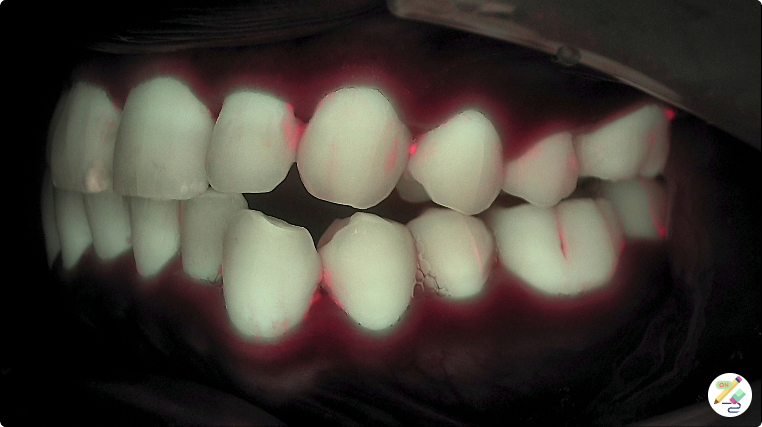
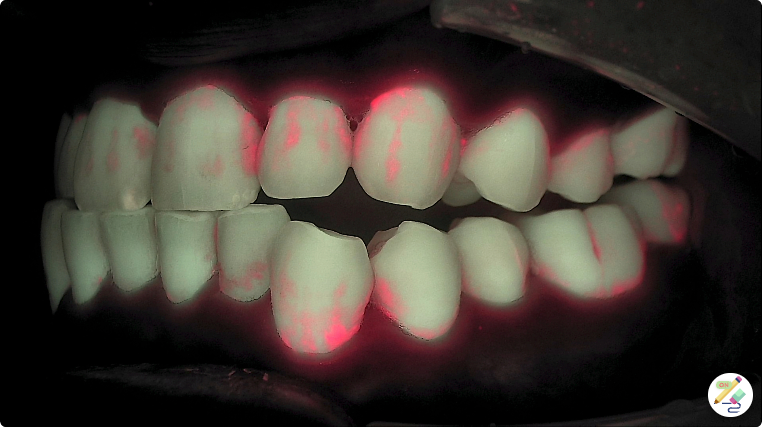
At the start of a care plan, a short interval shows whether the first changes are taking hold. These lateral Qray fluorescence images come from a patient in their thirties who had just decided to take their oral care seriously, captured 17 days apart. On July 27, red fluorescence shows at several sites on the labial and cervical surfaces of the upper teeth and around the lower canine and premolars. On August 13, the same sites show noticeably less red. In between, the patient was using Qscan Plus at home to see which areas needed attention while changing their brushing routine, and the next check was again set at a short interval.
Both images were taken from the same side, but distance and angle aren't identical. So the observation ("less red is visible") and the interpretation ("their routine has changed") are explained separately. If the change holds at the next check, you have a visible basis for talking about stepping the interval out.
What's next
Today's images go into LINKDENS and can reach the patient as a report that names the sites to recheck and when, so at the next visit you can pull up the same sites and compare them side by side. For how to put the next check into a report, see Dental Patient Report: What Happens When You Text the Image. For a practice owner, this turns the recall interval from a default into a commitment with a reason behind it, patient by patient. No one can guarantee rebooking, but you can show why this patient should come back in three months, or why this time six months is enough. As those comparisons continue visit after visit and carry into continuous care through QBLISScare, recall stops being the next cleaning date and becomes a regular check on the patient's health, done together.
FAQ
Q. What is the right dental recall interval?
A. There isn't one interval that fits every patient. The dentist sets it individually from plaque control, caries, periodontal and crack risk, and restorations or implants. Some practices work with tiers such as 3, 4, 6 and 12 months, but that's one example, not a rule.
Q. What is risk-based recall, and can a Qray fluorescence image decide it?
A. Risk-based recall means setting the interval from each patient's risk rather than a fixed schedule. A Qray fluorescence image is one input: it shows where mature biofilm sits and how that changes between visits. The decision comes from the dentist, together with probing, bleeding, radiographs and the patient's risk factors.
Q. Should prophy frequency vary from patient to patient?
A. How quickly biofilm and calculus come back, and the state of the gingiva, differ from patient to patient, so the right timing for professional cleaning can differ too. Recapturing under the same conditions at the next visit makes it easier to see whether the interval you chose was right for that patient.
References
- Kim YS, Lee ES, Kwon HK, Kim BI. Monitoring the maturation process of a dental microcosm biofilm using the Quantitative Light-induced Fluorescence-Digital (QLF-D). J Dent. 2014;42(6):691-696. DOI
- Lee ES, de Josselin de Jong E, Kim BI. Detection of dental plaque and its potential pathogenicity using quantitative light-induced fluorescence. J Biophotonics. 2019;12(7):e201800414. DOI
- Guk HJ, Lee ES, Jung UW, Kim BI. Red fluorescence of interdental plaque for screening of gingival health. Photodiagnosis Photodyn Ther. 2020;29:101636. DOI